I once attended a seminar led by Pastor Mike Bullmore where he taught that the gospel is connected to gospel truths and that those gospel truths feed and fuel our gospel conduct. Such a simple concept, and yet it was revolutionary for me at the time.
It’s easy for me to jump straight from the gospel to gospel conduct. In other words, I first recognize that Christ died for my sins, was buried, and was raised on the third day (1 Cor. 15:3–4) and then look to engage in loving others (1 John 4:19), forgiving others (Eph. 4:32), living in unity (Eph. 4:1–3), and more. And of course, the gospel does lead to such living. Faith works itself out in love (Gal. 5:6). We are to be doers of the Word and not hearers only (James 1:22–25).
But something is missing if we go straight from the gospel to gospel conduct without considering the kinds of truths that flow from the realities of what Christ objectively accomplished on our behalf. These truths remind the Christian of all the benefits that are ours in Christ by faith alone, and they remind us of our status such that we would work and bear fruit not for our salvation, but from it. Because of what Christ has done, we are reconciled (2 Cor. 5:17–19), redeemed (Rom. 3:24), adopted (Rom. 8:16–17; Gal. 4:4–6), sanctified (1 Cor. 1:1–2), cleansed (1 John 2:2), and justified.
Justification (which is my focus here) is the glorious truth that by faith in Christ alone I am declared to be “not guilty” because of the righteousness of Christ that is put onto my account. To have a status of not guilty is a courtroom concept. The judge has heard the entirety of our case, pounds the gavel, and in that moment, declares us innocent of all charges. We stand guilty before God in our sins (Rom. 3:23), and the deserved payment for our sin is condemnation and eternal death in hell (Rom. 6:23; Rev. 20:11–15). We are utterly hopeless to come out from under this sentence of condemnation in our own power. But God, being rich in mercy and love, sent his Son to pay the price for our sins (Eph. 2:4–9; Titus 3:4–7). Jesus bore our sins in His body on the cross (1 Pet. 2:21–24) that He might bear our guilt so that we could be declared not guilty by faith alone in Christ alone.
This beautiful truth of justification must be understood alongside of imputation. This latter term simply means that while Jesus bore our guilt—that is, it was put onto His account—we, by faith alone in Christ, have His righteousness put onto our account. We receive a righteous status from God through faith in Christ. Because Jesus was actively obedient throughout His life and willingly gave Himself up for us as a perfect sacrifice, his righteous status can become ours through faith.
Paul reminds us of this truth in 2 Corinthians 5:21: “For our sake he made him to be sin who knew no sin, so that in him we might become the righteousness of God.” Elsewhere he states, “Indeed, I count everything as loss because of the surpassing worth of knowing Christ Jesus my Lord. For his sake I have suffered the loss of all things and count them as rubbish, in order that I may gain Christ and be found in him, not having a righteousness of my own that comes from the law, but that which comes through faith in Christ, the righteousness from God that depends on faith” (Phil. 3:8–9).”
So, the biblical truth of justification, connected with imputation, is essential to rightly understanding our status before God and the nature of our salvation. Paul claims, “We ourselves are Jews by birth and not Gentile sinners; yet we know that a person is not justified by works of the law but through faith in Jesus Christ, so we also have believed in Christ Jesus, in order to be justified by faith in Christ and not by works of the law, because by works of the law no one will be justified” (Gal. 2:15–16). Christ’s righteousness is imputed to us, and we are declared not guilty, not by any works that we perform in our strength, but by faith in the accomplished work of Christ’s death and resurrection. Justification is a gospel truth that serves as a crucial link between the good news itself and the way we are to walk in a manner “worthy of the gospel” (Phil. 1:27).
Let’s consider this practically. Romans 8:1 declares, “There is therefore now no condemnation for those who are in Christ Jesus.” To get the full import of this verse, we must consider all the wonderful teachings of this grand epistle. It is wondrous to behold the grace of God as outlined in the book of Romans. But for our purposes here, let us consider this one glorious gospel truth in connection to justification by faith alone in Christ alone.
We are sinners by nature. Our ancestor Adam stood as our head, and his status became our own—namely, sinful to the core of who we are (Rom. 5:12–14). We were under the wrath of God (Rom. 1:18–32), called to account to pay the penalty for our sins (Rom. 6:23). But God, both as just and the justifier, sent His Son to atone for our sins (Rom. 3:21–26). And because of our faith in Christ, we are not condemned; rather, we have life. Thus, the gospel truth of justification reminds us daily that we do not live under God’s wrath, but rather we stand in His grace, mercy, and love. We have eternal life in Christ (John 3:36).
This is the truth we stand on. We do not bring an ounce of our own merit to God when we stand before Him. We stand under our belief in the finished work of Jesus, such that on the day of judgment we receive reprieve, not condemnation. It is true on that final day, and it is true today, and it is true throughout the entirety of the Christian life.
If you ask Christians why they will stand before God and be forgiven, declared “not guilty,” on the day of final judgment, many can articulate the doctrine of justification. However, it is far too common to see Christians today still living under the weight of the condemnation of sin and operating as though what they do in this life will earn God’s favor in such a way that a part of their justification is self-generated. This is where we need to see our formal theology connect with our functional theology.
Jerry Bridges helpfully highlights that it is not enough to merely see the righteousness of Christ as all-sufficient; “We must see it as all-sufficient for us. Jesus was perfectly obedient in our place, as our substitute.” As such, while we work out our salvation with fear and trembling, we also recognize that it is God who is at work in us (Phil. 2:12–13). We work hard in our gospel conduct, knowing it is the grace of God within us that brings that motivation and work about (1 Cor. 15:10). We must actively work to see the righteousness of Christ imputed to us and the justifying work of the cross as all-sufficient for our salvation every day and as the fuel of our doing anything for the Lord.
The doctrine of justification reminds us that we are not condemned because of what Christ has done, rather than what we have done. We deserve condemnation, but if we are connected to Christ by faith, there is life and love that flows from God to us.
Thus, we must remind ourselves each day that we are in Christ, and therefore, we are not condemned. By faith in Him, we are declared “not guilty”; His righteousness is imputed to us. When we remind ourselves and preach these truths to ourselves each day, we rightly acknowledge that we were indeed hopeless, desperately lost sinners who have been rescued by the all-sufficient righteousness of Christ. We lean on Christ’s finished work. We look to it again and again. We declare the wonder of justification to our own soul. We recognize that any good work that proceeds from us flows from our being justified by grace through faith, not some means of attaining saving favor with God.
What good news, friends! The gospel of Jesus Christ includes the gospel truth of justification by faith alone. Christ’s righteousness is imputed to us. We are not condemned but live as new creations in Christ (2 Cor. 5:17).
Yes, we will still sin. But that sin, our sin, has been dealt with in the death and resurrection of Jesus. Justification frees us from self-condemnation as we understand what Christ has accomplished in our stead. And the gospel truth of justification fuels us to live as free, enlivened, empowered followers of Jesus, glorifying him in all things.
Thus, we remind ourselves of these truths in our own reading of the Word. We join a church and live within community where we will be reminded of such realities. Such a people, justified, not condemned, free, alive in Christ can live in ways that proclaim the gospel in their joy-filled demeanor and their bold, gracious gospel-centered words.
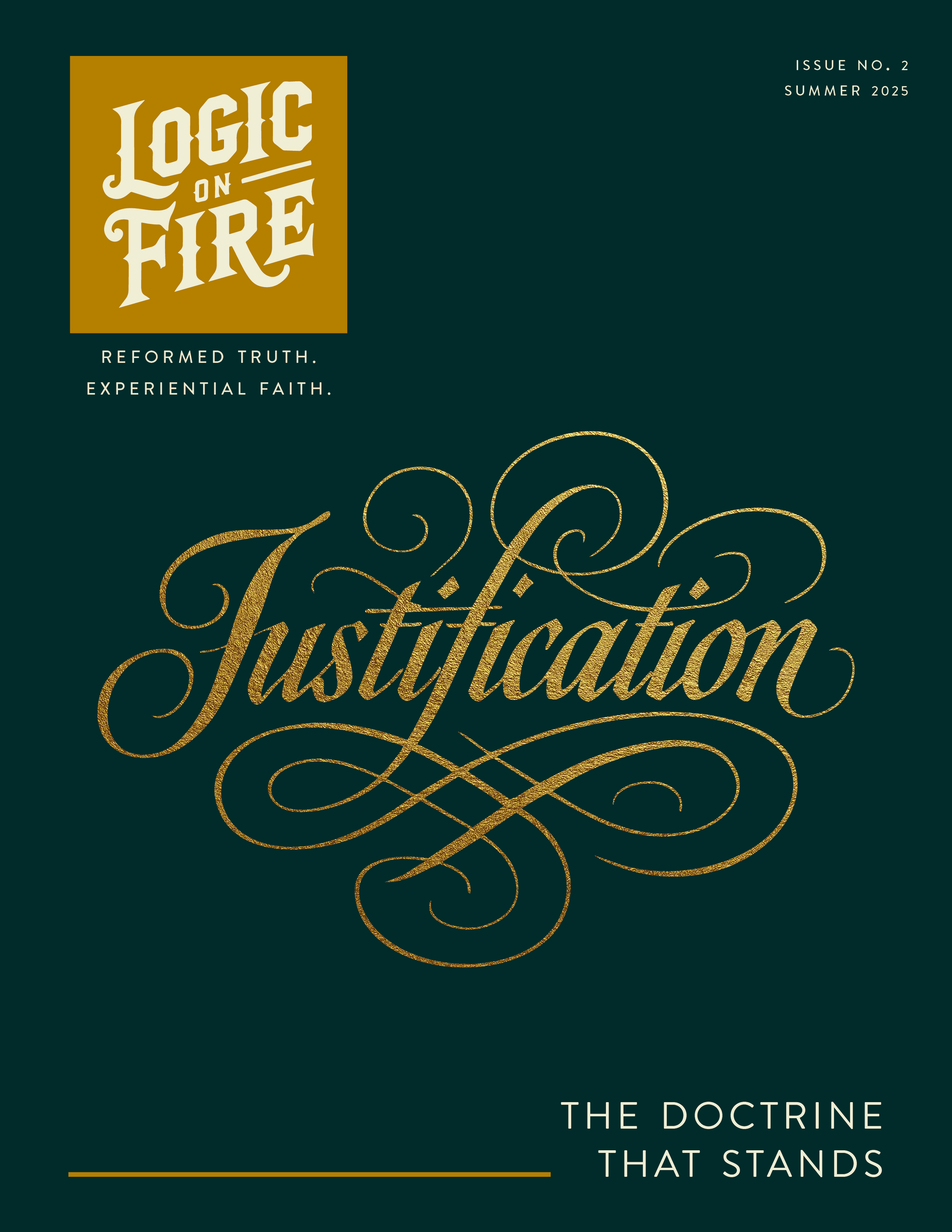
This article was originally published in the second issue of Logic on Fire Magazine, titled Justification: The Doctrine That Stands. A ministry of Unashamed Truth, Logic on Fire is devoted to thoughtful, biblical, and theologically rich writing that seeks to unite sound doctrine with the lived experience of the Christian faith. Each issue is designed to strengthen the church, encourage believers, and deepen a love for Christ and His Word. Subscribe to Logic on Fire Magazine to receive future issues and enjoy faithful writing from pastors, theologians, and Christian leaders.