What are some practical strategies for sanctification?
At the King’s Chapel, we have recently been studying the book of Titus. And one of the fascinating themes in Titus 2 is Paul’s emphasis on self-control, as he exhorts three groups of people to exercise it (see vv. 2, 5, 12).
In 1 Corinthians 9, when Paul described his own life of sanctification as an effort in self-control, he said, “So I do not run aimlessly; I do not box as one beating the air. But I discipline my body and keep it under control, lest after preaching to others I myself should be disqualified” (1 Cor. 9:26–27). Self-control is the baseline virtue of all Christian sanctification. And that logically makes sense, because the virtue of self-control means that the Christian is able to say no to their lustful desires and the fleshly appetites that contradict the will of God. Here are some practical steps we can take in our own lives to become more self-controlled.
First, to be self-controlled, the Christian relies on God’s power through prayer. We will not defeat sin over which we are not praying for victory. We must rely on God’s power. Christ in us is the hope of glory (Col. 1:27). It is no wonder that Paul exhorted the Ephesians to “be strong in the Lord and in the strength of his might” (Eph. 6:10). Paul reminded them that in order to face Satan’s tactics, they must be strengthened by God (a passive verb—meaning it is something God does to us!). Paul then closes the section on the armor of God by saying, “Praying at all times in the Spirit, with all prayer and supplication” (v. 18). All victories in self-control are the result of God’s strength and power through prayer.
Second, the Christian must learn to put to death the deeds and lusts of the flesh in their own lives. Paul exhorted the Romans, “For if you live according to the flesh you will die, but if by the Spirit you put to death the deeds of the body, you will live” (8:13). Just because we are Christians does not mean that we are immune to sinful ideas and desires. They frequently spring into action, like a lion on the prowl in our very soul, awaiting an external temptation on to which to cast themselves and deliver us over to sin. Paul reminds us that we must not give the internal sinful desire the chance. Rather, when we see anything in our own thinking or heart that we know is sinful, we are exhorted to “put it death.” This means that we give it no quarter. No mercy. We vanquish it. For, as John Owen said, “Be killing sin, or it will be killing you.” We are to relentlessly and violently cut off our own sin (Matt. 5:29).
Third, again and again, the Christian is exhorted to put on Christlike virtue. Self-control is about much more than not falling into sin. It is also about putting on Christ. We are to put off the sinful desire and put on the godly desire. Paul urges in Colossians 3:12–13, “Put on then, as God’s chosen ones, holy and beloved, compassionate hearts, kindness, humility, meekness, and patience, bearing with one another and, if one has a complaint against another, forgiving each other.” He gets at the same idea in Romans, saying, “But put on the Lord Jesus Christ, and make no provision for the flesh, to gratify its desires” (13:14). We are to not only avoid temptation; we are to run headlong into holiness. We are to pursue Christlikeness with all of our being.
Fourth, in addition to these three methods, the Christian must constantly be seeking the renewal of the mind through the Word of God. Again, Paul stated in Romans 8, “For to set the mind on the flesh is death, but to set the mind on the Spirit is life and peace” (v. 6). The battle for the Christian life is largely in the mind. We become what we think. Therefore, our minds are to be dominated by Scripture, and through this renewal, we will be transformed (12:2). This includes Scripture memorization and meditation (Ps. 1:2). The giants of the Christian faith have all traveled a well-worn path. And that path has Bible memory and meditation at the center of it. We neglect this final discipline at our own peril. As the psalmist declared, “I have stored up your word in my heart, that I might not sin against you” (119:11).
So, self-control is not some pie-in-the-sky virtue. By God’s grace and with God’s help, every Christian can learn to pray and weep over their sin, to put their sin to death, to put on the Lord Jesus Christ, and to be continually transformed through the renewal of the mind.
What is the difference between eternal security and the perseverance of the saints?
In some ways, “eternal security” and “the perseverance of the saints” refer to the same reality. That being said, most evangelicals have only been well taught the “assurance” aspect of eternal security—the glorious truth that genuine, born-again Christians will never lose their salvation. Eternal life is a reality that Jesus promised to all those who believe in Him (John 3:16; 17:3). And if you possess eternal life, then you can never lose eternal life, logically speaking, because it is eternal! Along these lines, Jesus’s words in John 10 are a great comfort:
My sheep hear my voice, and I know them, and they follow me. I give them eternal life, and they will never perish, and no one will snatch them out of my hand. My Father, who has given them to me, is greater than all, and no one is able to snatch them out of the Father’s hand. I and the Father are one. (vv. 27–30)
We could talk about numerous other verses that speak to the fact that the believer’s soul, once saved, is completely secure (see Rom. 8:30; Phil. 1:6). But for the sake of brevity, let’s move on to why we need to understand another aspect of eternal security, which is sometimes called the perseverance of the saints or the preservation of the saints.
In addition to teaching the doctrine of eternal security of the believer, the New Testament also teaches that all genuine believers must persevere and will persevere to the end of their mortal lives in the faith. That is why Paul stated in his final will and testament in 2 Timothy 4:7–8, “I have fought the good fight, I have finished the race, I have kept the faith. Henceforth there is laid up for me the crown of righteousness, which the Lord, the righteous judge, will award to me on that day, and not only to me but also to all who have loved his appearing.”
Notice that Paul conditioned the “crown of righteousness” on his persevering faith that enabled him to “finish the race.” The logical implication is clear: if Paul had not finished the race, he would not have won the crown. For this reason, to the Corinthians, Paul said, as we saw above, “I discipline my body and keep it under control, lest after preaching to others I myself should be disqualified” (1 Cor. 9:27). This is Spirit-wrought self-control, but it is self-control nonetheless. Every Christian must exercise this type of self-control in order to continue to follow Christ and not be disqualified from inheriting the Kingdom.
If all this sounds new to you, this may be because the evangelical church has been quick to offer assurance and eternal security to anyone who makes a profession of faith without emphasizing the other necessary wing of the plane, which is the absolute, non-negotiable that that faith must persevere to the end. But we have confidence of this, that those who are “sealed with … the Holy Spirit” will necessarily persevere to the end (Eph. 1:13). The Holy Spirit keeps us from falling away. This is why it is also called the preservation of the saints.
You might ask about those who make a profession of faith, but do fall away. John writes, “They went out from us, but they were not of us; for if they had been of us, they would have continued with us. But they went out, that it might become plain that they all are not of us” (1 John 2:19). In other words, those who do not finish their life in faith never possessed genuine faith to begin with.
How does the doctrine of unconditional election affect our view of sanctification?
The Scriptures teach that our triune God, before the foundation of the world and even time itself, chose a people from Adam’s fallen race to be saved (see Eph. 1:3–11). In fact, we find out that their names were written in the Lamb’s Book of Life “before the foundation of the world” (Rev. 13:8). Therefore, Scripture teaches that the salvation of God’s elect (chosen ones) is certain, because God planned it, God accomplished it, and God will bring it to completion. This is Paul’s logic in Philippians: “And I am sure of this, that he who began a good work in you will bring it to completion at the day of Jesus Christ” (1:6). God’s plans are irrevocable. His promises are sure. Notice how Paul grounds all of our salvation, including our ultimate glorification, in God’s sovereign plan of election:
For those whom he foreknew he also predestined to be conformed to the image of his Son, in order that he might be the firstborn among many brothers. And those whom he predestined he also called, and those whom he called he also justified, and those whom he justified he also glorified. (Rom. 8:29–30)
Therefore, Paul asks a few verses later, “Who shall bring any charge against God’s elect? It is God who justifies” (Rom. 8:33). Indeed, God’s choice of His people before the foundation of the world is incontrovertible. All those who are called will be justified. All those justified will ultimately reach perfect sanctification, which is also called glorification. Therefore, the Christian can rest assured that their sanctification is guaranteed.
Again, as we have seen, this does not mean that we sit on our hands waiting for God to sanctify us. No, with God’s help, we use the means that He has given us to pursue Christlikeness. We rely on His strength and power, trusting that God will bring our sanctification to completion as we study God’s Word, encourage one another to keep persevering, worship with Christ’s saints, seek the Lord in prayer, and take the Lord’s Supper with the gathered assembly.
In some ways, this means that our sanctification is like playing a football game where we are already assured of the outcome, even knowing the final score. But with that assurance, we still have to go play the game. It was this way for the children of Israel entering the promised land. They were assured of victory over their Canaanite enemies, but they still had to walk in faith fighting the battles as “strong and courageous” men (Josh. 1:9). So we too must step out in faith, fighting the battle of sanctification, knowing that our ultimate victory has already been secured in eternity past in God’s glorious decree of election and purchased in history by our Lord and Savior Jesus Christ.
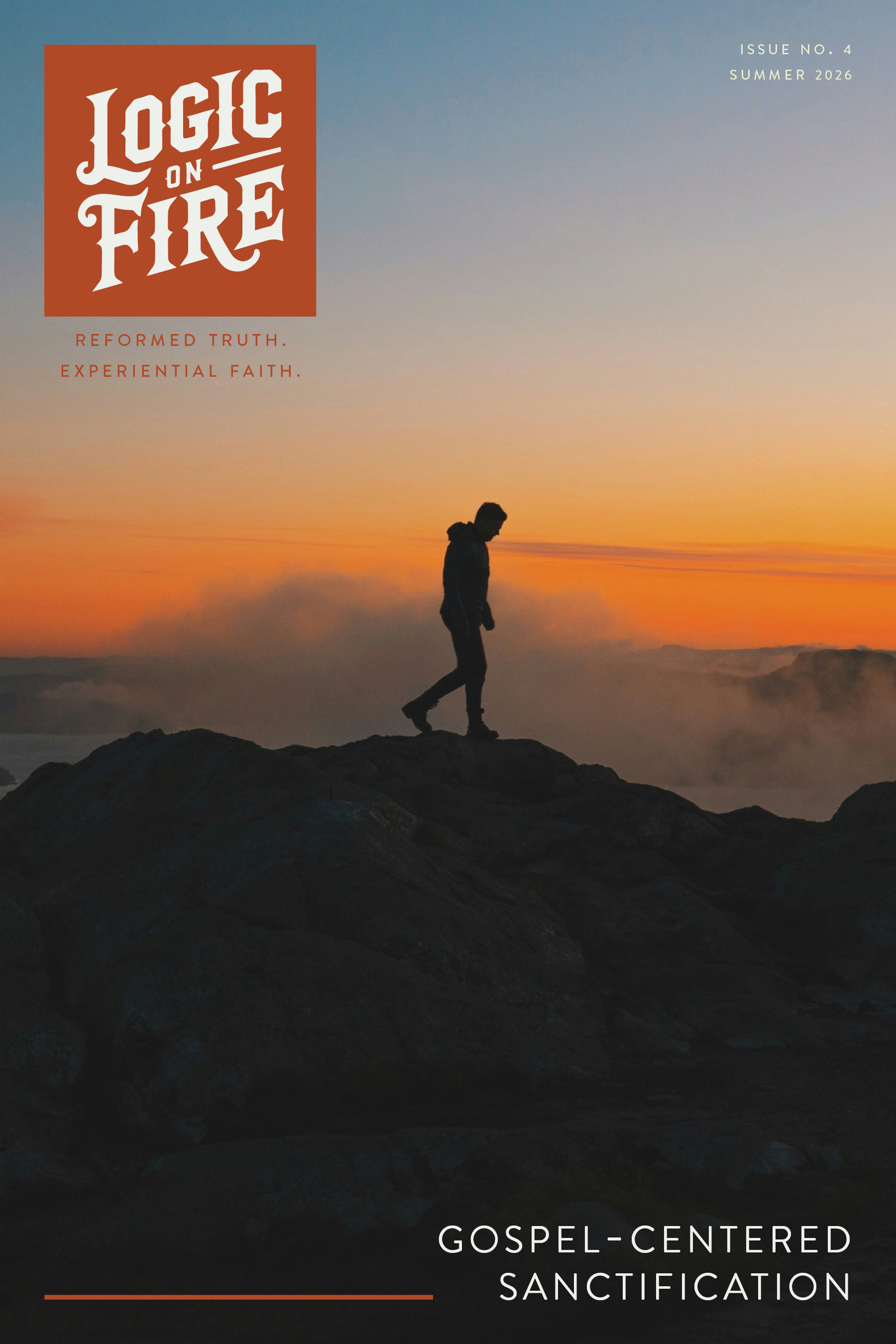
This article was originally published in the fourth issue of Logic on Fire Magazine, titled Gospel-Centered Sanctification. A ministry of Unashamed Truth, Logic on Fire is devoted to thoughtful, biblical, and theologically rich writing that seeks to unite sound doctrine with the lived experience of the Christian faith. Each issue is designed to strengthen the church, encourage believers, and deepen a love for Christ and His Word. Subscribe to Logic on Fire Magazine to receive future issues and enjoy faithful writing from pastors, theologians, and Christian leaders.